Showing posts with label pic st loup. Show all posts

Wednesday, April 7, 2010

A Pioneer in Pic St. Loup


When I began my life in the world of food and wine in Arles, it didn't take long for the region of Pic St. Loup to become known to me. Ahhh it has the most perfect climate, hot in the day time but cold at night. It creates the perfect grape: all skin and seeds and minimal pulp.

I heard names, Hortus, Lascaux, and a bit to the side, La Grange des Pères. When Erick and I began our wine tours -- three days of intensive wine touring, two market days and cooking every night -- we were sure to include the Languedoc region and in particular a trip to Pic St. Loup. We were never disappointed.

So as I manoeuvre my way into the world of a wine agent I am excited and decided upon having a winery of Pic St. Loup in my portfolio. And what a choice! I am working with Château de Cazeneuve, owned and operated by Andrée Leenhardt one of the persons responsible for remaking the reputation of this region.

While I roamed his vineyards, explored his cellar and tasted his wines (for a second time, but this time with a bit more presence and focus) he shared his history with me.


Andrée arrived in Pic St Loup with a science degree and a passion for agriculture. At that time, he was considering raising sheep. A first job as a technician at the local Chambre d'Agriculture brought him into contact with the local farmers and vintners. It is there that he learned of the upcoming sale of the Cazeneuve property and managed to purchase the portion devoted to the winery. This was in 1987, a time when the region was scorned by the decision makers for the AOC Côteaux de Languedoc.

However, where there is vision... Where there is a will...

Andrée was not alone. In the beginning the goal was to be accepted into the Côteaux de Languedoc AOC. Gradually the number of vintners active in this mission would climb to over thirty, from a cluster of villages surrounding the Pic. Together they raised the standards and put Pic St. Loup on the map. They helped choose the grapes for the appelation: Grenache, Syrah, Mourvèdre, Cinsault and Carignan. They decided that they would seek quality and aging potential over quantity and quick sales. Thus many age their wines in oak casks for a minimum of a year and in Andrée's case 18 months.

And, with such momentum and faith, they have brought the reputation of Pic St Loup to such heights that it is now its own AOC and surpasses the Côteaux de Languedoc by both the strictness of their rules (no more than 45 hectolitres per hectare) and by the quality of the wines.

Andrée and many of his colleagues have rebuilt their cellars and invested in high quality vinification and storage tanks. At Château de Cazeneuve, Andrée put in the necessary equipment to permit filling the tanks from above using gravity, increasing concentration and skin extraction by using Pigeage rather than pumps to aerate the fermenting liquid.

Currently mayor of his village Lauret, he is collaborating with his neighbors to put in place a wine route showcasing the numerous local tourism possibilities from lovely bed and breakfasts to chic local restaurants.

I can see now a future in hiking and biking tours...
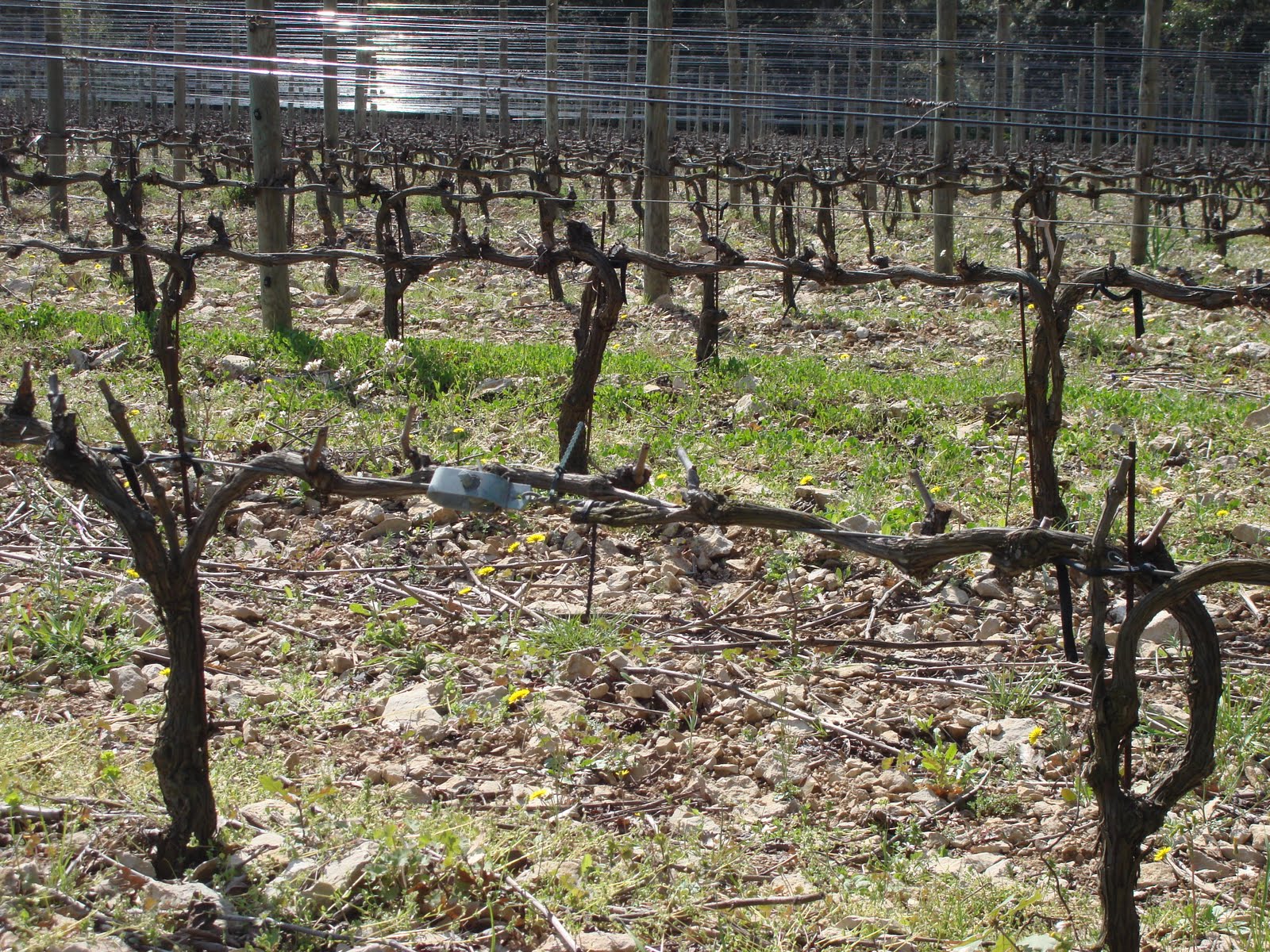
The Pic St. Loup region is a young region and the Château de Cazeneuve is a young winery. All the vines were planted over the past 20-30 years. And Andrée is still planting. He likes a white wine with rich and varied notes, cask-fermented. He has thus planted white grenache, viognier, roussanne, marsanne, rolle (aka fermentino) and muscat grapes. He will soon add another parcel to his whites on land he has himself cleared and prepared, no more than a hectare (2.2 acres) 400 meters higher in altitude than his other vineyards. Finding his white truly delicious, I'm delighted to note that Andrée has chosen to make a good quantity of white -- 25% of his full production -- so there is enough to export!

That the vineyards are young (but now old enough to produce concentrated grapes) is a plus. The vintners of this region are rarely plagued by problems of poor and over-taxed soil, nor with insect infestations. Surrounded by woods and isolated from other cultivated fields or orchards, they can more easily opt for organic methods with little worry of contamination.


After chatting, exchanging, learning and enriching our friendship, I walked away with two of his wines (I can't carry more at the moment!) to bring with me to Portland, OR and this summer to Chicago. His lovely white (hmmmm) with a rich blend of five of his grapes, supported by the rich Roussanne, cask-fermented and designed to age beautifully (oh the 2006...) and his classic cuvée, Les Rocs des Mates of grenache, syrah and mourvèdre aged in cask. The dense and rich grapes are balanced by their passage in oak (multi-passage), leaving the tasting with a sensation of pleasing freshness. I inhaled a blend of spices and toasted notes. A masculine and concentrated wine with good aging potential.

Tuesday, April 6, 2010

Domaine Coston


When a family chooses to work together much is possible. A father who encourages and offers responsibility to his sons, an elder brother who admires and follows his more experienced younger brother. And yes, Mom who holds up the rear coping on all that tiresome administrative paper work! But then again, this was her property, her dowry. She inherited it when she was only eighteen and her husband joined her to manage it till their sons were of age.

When a team such as this unites, what can stop them? The Coston family is now into its fifth generation of wine makers. They've owned their village home and cellar in Puéchabon along with various parcels of vineyards in the surrounding hills and plateaus for nearly forever. And now they are expanding and exploring new options.

The sons, Philippe 35 the man in the cellar, Jean-Marie 39 main marketing man and cellar assistant, joined their father -- the primary person managing the vines -- in 1998. Quickly the choice to cultivate organically became both desired and obvious. Living and breathing phyto-chemicals one more year was out of the question.

Strong arms and youth have led them to renovate, replace and improve. The cellar is filled with small stainless steel tanks permitting the individual vinification of each parcel and each grape varietal. The top cuvée red is aged in new oak, about a third of which is renewed yearly. The tasting room is beautifully and simply renovated, with a majestic stone well right there (should you prefer water to wine), an ancient iron wheel with spokes its protective door.

The vines range from fifteen years' old to sixty (the vieille vigne Carignan). And shortly, there will be eight new hectares (18 acres) planted in the red varietals so cherished in these parts: Syrah, Grenache, Mourvèdre and a handful of Cabernet Franc.

I came to visit, to taste, to see. But to see the vineyards you have to hop into a jeep and head off to the hills. The Coston family has purchased land high up on the plateaus of their region. After passing by a château, neighboring vineyards and abandoned olive orchards, we headed up a rutted and rough dirt road, through the scrub oak and herb encrusted limestone range (perfect for hiking and mountain biking!). Till... we arrived.


For the serious oenophiles amongst you, it is possible that this road, and the land that lines it has a familiar look to it... Anyone remember Mondovino? Well, when Robert Mondavi and his family were unable to purchase this parcel of land in the Languedoc, it went back on the block. Or actually, when he attempted to purchase it, the French agricultural governmental agency that tries to keep good land in the hands of those who will till it and cultivate it opened up the sale to local vintners and through a strenuous list of criteria selected the Coston family as the beneficiaries of the right to purchase. Thus, though they couldn't put the funds forth that Mondavi might have, they were able -- after ten years of haggling and persistence -- to obtain this land.
They have now done to a portion of it what Mondavi would have done to all of it. They have removed the Garrigue and chewed up the massive limestones to render the area plantable. It is somewhere between a lunar landscape and the top of a barren mountain. Gone are the wild oak, the rosemary, the thyme. And with the passage of the massive stone crusher, what was monumental stones has become shale.

The view is fantastic, the site extremely promising, and the possibilities tantalizing. Down below are the vineyards of the Grange des Pères, long a favorite of the region.

With this land the family will not quite double their production. Plans to expand the cellar are already necessary. Perhaps it is a good thing that grape vines require a minimum of three years before they become productive.

Meantime, the next generation -- currently 5 1/2 and 3 months -- will grow and who knows? Happiness and success is contagious after all.

But yes, it is a winery, right? And I am looking to bring their wines to the US -- currently to Portland, OR and to Chicago this summer. This was the (ostensible) reason for my visit (and for my brief moment of being lost as I manoeuvred around Montpellier).

After tasting all five of their wines I chose two of their range to bring with me to the States this year: their white which I found rich in orchard fruit and yellow flowers, long in the mouth, aromatic and pleasantly different. It is made with Roussanne (think Châteauneuf-du-Pape, a concentrated and rich grape that ages well) and Grenache Blanche. I tasted the 2006 and was quite wowed.

My favorite of their three reds (a vin de pays, their classic and their top cuvée aged in wood) was their classic. Called Les Terrasses du Larzac it is their coeur de gamme. It was simply (and most carefully) vinified in stainless steel tanks, no wood. The pleasing result is deep fruit flavors of black cherries and exotic spices. Mmmmm