I love this expression, mes acquis. That which you have acquired, that which you own, and in this sense, my skills and knowledge. In the many years, the many lives, the many projects I've managed, I've come away richer in much, if not in gold.
As I put my efforts to creating a fulfilling life in a beautiful community, known frequently as a place where, "half the pay is the bay," I am tapping into my various skills, and rediscovering how deep my knowledge is, and how it might carry us forward.
Wine and teaching. I've done so much of both. So, it's rather a natural progression to develop this angle further. The last time I hoped to make wine a major part of my professional life, the timing was terrible. The dollar was weak. The US had just experienced the financial crash/housing crisis, and I was hoping to use my experience at the side of an organic vintner to sell French wines to the US distributors. To do so, I honed my tasting skills, my teaching skills, and my knowledge of the wines themselves. However, I did not have the personal nor professional funds to ship and carry wines to the US repeatedly in order to find those importers/distributors. Too late I realized that one must present wines again and again, proving consistency and professional commitment, before finding a business partner. And so, for the time being, I shuttered that possibility.
Yesterday, after a fruitful discussion with a colleague who runs a professional culinary school, I've submitted a proposal for an intensive wine tasting and food and wine pairing program for his students. As I put it together, it was so clear how I would progress, what subjects were important to cover, how I would balance the intellectual and the practical.
I think back to the many wonderful professional wine tasting experiences I've had, with the top experts in the field such as Karen MacNeil, with my chef sommelier in Châteauneuf-du-Pape, Guy Brémond, with the many vintners who received me generously into their wineries and explained at length the processes they used, tasting from the barrels, tasting from the tanks, tasting bottles both young and old, tasting, savoring, describing, explaining. And yes, I remember back to the years I spent alongside an organic vintner who shared every step of his world with me. Thus, I've been there, from harvest through winter pruning. I've been there to taste and blend with the oenologist. I've been there at wine fairs, tasting, selling, discussing.
And then there was that huge translation project I (happily) plowed my way through, the Bettane & Dessauve. All the tasting notes for every wine they considered worthy, throughout every region of France (except Burgundy and Bordeaux, which my colleagues kept for themselves). I put together a massive list of specialized vocabulary, and eagerly went out to taste some of the most interesting options.
So, add in my Waldorf teaching experience, and the twelve years' running a cooking school in Provence, and well, what a perfect fit! Stage one - wine intensive; stage two... sensory analysis on a deeper and wider level: cheeses, beers, chocolate.
So, the proposal went off yesterday. We shall see...
Showing posts with label wine. Show all posts
Showing posts with label wine. Show all posts
Tuesday, September 22, 2015


Wednesday, September 8, 2010
Wine tasting -- just before Harvest

A day of wine tasting: the weather was perfect, the clients lovely, the wines superb, the wineries welcoming. All that one could wish for right? Well, let's make this a two part article. This part is all about the wine, and the next one will be about the 'glitch' we experienced. That is, ahem, technical difficulties. Or, as I occasionally view these things, a test from the universe. But I'll get to that later.
My seven dynamic, young and multi-national clients and I started the day by heading off to Châteauneuf-du-Pape, Clos du Caillou in Courthézon to be exact. There we were warmly received on a Monday (a day they don't normally do tastings) and just after harvest had begun (and the day before a serious rain storm!). Privileged as we were, we tasted the full range of wines they have:
Two whites (one marvelously concentrated clairette, and one blend of roussanne, viognier, grenache blanc and clairette). The first was bright and lively in the mouth, rich in citrus fruits (grapefruit) with a nice length to it. Hmmmm - yes, I brought home a case! It was their Côte du Rhône 2009. The second was quite different, from 2008, softer, warmer, more orchard fruits, creamier, and yet this one too had not gone through oak. We were tasting the grapes and only the grapes.

Onward to their two red Côte du Rhônes -- these differing in their vinification. The first rich in grenache, syrah and mourvedre, and vinified/aged in cement tanks. The second a similar blend but aged as they do their Châteauneufs, that is 18 months in large oak barrels.

I'd been to taste at this winery before, and as I remembered, they have great Châteauneufs, but I remember being blown away by their 'smaller' wines, their Côte du Rhônes. The winery is situated just beside the far better known Domaine Beaucastel, and like their neighbor, they too are working organically and soon bio dynamically -- always a good sign.
These wineries are located in a small island apart from the main portion of Châteauneuf AOC. If you see the map of Châteauneuf, you see one large chunk delineated and marked out, and then a small chunk of land off to the West, with more winery land between it and the large chunk. It's rather complicated to understand -- no doubt a political choice back when the geographic outlines of the AOC were determined. In any case, that line of land between the big and little chunks? well it has lovely vineyards too, but they can't be called Châteauneuf-du-Pape. This is where the Clos du Caillou Côte du Rhône vineyards are and do they make a magnificent one! It is the rare Côte du Rhône that could be mistaken for a Châteauneuf -- truly jammy and dense in flavor and bouquet, not farmy or vegetal or rude at all. And yes, I brought home a case of each too.
Their bonafide Châteauneuf-du-Papes are nothing to sneeze at. Truly they are dense and chewy, jammy yet fresh. The 2008 has finesse and elegance, something to drink soon or in ten years when it will no doubt evolve to new heights.

It was as we were leaving this elegant winery, after visiting the aging cellar and seeing their casks of three dimensions -- small and medium size new/multi-passage oak barrels and large casks. Yes, as we were trying to leave this winery that my car went kaput. Silence. Lights yes, but no motor, not even after pushing it down hill and putting it into second (something I'm quite skilled at after these past couple of years on my own). Nope. It chose to not budge. However, I shall go into detail on this event in the next post. Here I will continue with our tastings which -- after an unexpected and unintended pause of about 2-3 hours, did continue!
And so, later than desired, thirsty and eager, we arrived at our second winery, Domaine Jean David in Séguret, a village of the Côte du Rhône Villages region. I've known Jean David for years now and adore his selection of organic wines (he's a pioneer and a devoted one at that in the organic world).
 We were able to taste his white -- a blend of roussanne and bourbelenc (that unusual grape in the 13 cépages of Châteauneuf-du-Pape) vinified in stainless steel. It is a simple and pleasant white with notes of orchard fruits and flowers. Then onward to his selection of reds, which is quite wide these days. He has a Côte du Rhône with a funky new label in reds with green notes (designed by his daughter and appreciated by his Japanese clientele), his 'green label' Côte du Rhône Village Séguret -- a lovely, concentrated classic to be appreciated often.
  His very special cuvée Le Beau nez (or le Bonnet) identified by an image of a man with either a red nose, or a red knit cap!. This is his drink it now no-sulfites wine. Rich in fruit, dense, high in alcohol. Enjoy now! Tomorrow may not come. And, with his oldest vines -- 50-80 years' old -- he makes his splendid Les Couchants. A dense and nearly syrupy grenache dominant blend. Wow. None of these see wood. He's a purist of his grapes and his terroir. And all are worthy. From the simplest to the most complex.
Jean David told us stories about how he came to work organically (much against his father's wishes!) after tasting fresh organic vegetables from an 'older brother's' garden. He is just a tad younger than the "soixante huitard" generation, one marked by the return of many young people to the countryside, fleeing the materialism and regimen of city life. He was an early convert, and due to his father's animosity at such backward thinking, set off on his own to travel Europe on foot for a year rather than back down. His father finally agreed to pass him 5 hectares (12 acres) to work in his new fangled ways. And, yes, Jean David and his wife Martine were able to make a go of it. Slowly, he took over more of the family vineyards and surely, he did it his way. His father still has moments of contrariness to all this, but grudgingly respects his son's dream and realization of it.

From Jean David's we took a quite ten minute ride to Gigondas, the second best known "cru" of the Southern Rhône wines. (the first being Châteaneuf-du-Pape). Our destination was a young winery with a young winemaker -- Domaine Les Florets. It's dynamic vintner--of almost local stock (a couple villages' away) has been in place since 2006. A young father of three he is working a small area of vineyards (8 hectares, which is actually about standard for the AOC) with a few extra hectares in Cairanne (another of the Village wines). Young, working organically (if not as yet certified as such), he has taken on vineyards high up in the hills (a tiny tractor could get there, but not much else!) and is perfecting his own recipe for a spicy, berry-filled yet refined and elegant Gigondas. His is not the chewy power punch of many who have vineyards lower down the slopes. His is surprising and pleasing. And he's willing to have me represent him towards the US. What a treat!

He has a rich and flavorful rosé -- grenache, syrah and cinsault. A marvelous and fruit filled Cairanne -- quite startling in the expression of ripe red berries. His classic Gigondas -- with no oaks -- and his far more heavily oaked special cuvée (a blend of grenache and mourvedre) which was spicy, tobacco, and for some reminiscent of a Barollo... Quite the surprise. It will be interesting to see where he goes as the years pass, and to accompany him for part of that voyage!
With vineyards high up in the hills, he is not yet ready to harvest (perhaps next week?) and will be harvesting through to mid/late October! Quite late compared to other Souther Rhône areas. We chatted about the chilly Mistral winds of last week, the soon to be upon us rain storms (not as yet a catastrophe -- the water could help finish off the ripening, particularly if it is followed by sun and some good breezes), and the possibility of returning to see how things are advancing and even/maybe joining his harvesters up in those hill-top vineyards to pick a bit? perhaps a hike to be followed by... -- I think I've now decided where we'll be hiking late September with my group!
As per my methods (and pleasure) I purchased wine in each of the wineries -- one of the ways I maintain my contacts and a way to be received warmly the next time. So, should you be stopping by to visit.. perhaps I'll pull a lovely bottle out for you?
Wednesday, July 14, 2010
A meal for wine
Though it's not completely easy at this point, I am periodically working with JP as the chef to his wine tasting courses, or the co-host for his Japanese guests, etc., And, I rise to the occasion. I'm never paid enough. But is anyone when it comes to food prep? It's a wonderful world to be a part of, but it is not one where the hourly wage is particularly high. Thus, I do it for the experience, and to learn myself.
This time the givens were: 8 guests, wines of many a varietal discovered during the tastings, a very hot summer's day, and a specific request for both fish en papillote and meat in sauce. So, I went to work:
I do apologize that there aren't photos here -- I was focused on the other tasks at hand and completely neglected to visually document the event and its components.
First course: a cold summer fruit gaspacho:
1 large melon and 1 small (orange flesh, but honey dew would have been lovely too)
1 large cucumber
the juice of 2 lemons
two tablespoons of fresh lemon thyme, though mint might have been interesting
salt and sugar to taste
3 small apricots diced
1 yellow bell pepper roasted, peeled and diced
I mixed the first three ingredients in the blender -- it made two blender-fulls, about 2 1/2 quarts. I poured these into a large bowl and added salt and sugar to taste. I then went to the garden to get the lemon thyme, snipped it and sprinkled it in. I put this blend aside in jars in the freezer for the next day.
The next morning I took the jars from the freezer to defrost. When I could, I poured them into the soup tureen, stirred them a bit, then added the diced yellow bell pepper and apricot before serving.
For the soup -- completely lacking in fat and having the acidity brought by the lemon juice and the fresh apricot -- we decided that amongst the possibilities for accompaniment the lusher viognier (though this was a relatively tart viognier, not heavy on the honey and apricot direction at all) and roussanne blend from the Languedoc were far more agreable than the tart sauvignon blanc or chablis.
Next up was the salmon en papillote on a bed of yellow squash. I sprinkled anise seed below and above the salmon, a pinch of salt, a tiny squirt of lemon and a drizzle of olive oil before wrapping up my packets and baking gently till done. The softened squash really added a lovely additional texture to the dish, and the delicate anise was just the right note. We found that this softer dish was enlivened by a non-oaked chardonnay, and not bad at all with the tart sauvignon, though I also appreciated the floral rosé from the Costières.
The pork roast I fixed with sun-ripened cocktail tomatoes, onions and roasted garlic. I added sprigs of rosemary from my garden, a drizzle of olive oil, 3 tablespoons of honey and salt. Super simple. I browned the roast, then removed it from the pot. Added the onions and more olive oil and cooked till soft, then I put in the tomatoes cut simply in half, and the garlic cloves whole. I simmered till reduced and put the roast back in. I put the sprigs of rosemary on top, let cook 20 minutes or so covered and then removed from the heat. This was all done the day before the meal.
The next day I took my pot out of the fridge and brought it over to the winery. I put it on the stove top and simmered it gently for another half hour, drizzling the honey over top. I then turned it off and awaited the moment to serve. It simply improved in its tart/sweet juices.
We paired both a rich Tavel rosé -- deeper in color and higher in alchohol than the pressé directe that you find often on the market these days, and a spicy, fruity syrah with this dish. With the tart/sweet notes and the white meat, it is truly a very flexible dish for pairing.
The last dish was a straightforward mousse au chocolat noir. And I mean noir! I don't like my chocolate mousse too sweet, it is 'écoeurant' to my palate. I had a barely sweetened fresh raspberry purée to accompany it, but put it on the side so that the wine pairing could occur with just the chocolate notes.
For our dessert we appreciated the rich and syrupy aged Jardin Secret from Domaine Cabanis (syrah dominant) from 2001, a younger and more on the fruit syrah from a neighbor that had been aged and concentrated in new oak, and a white rum. A smokey/toasted whiskey is also quite marvelous with chocolate.
And thus the meal concluded. Yes, there was a cheese course between the pork and the mousse, and it showed a perfect pairing between a creamy cheese of the Loire and the farmy Pinot from Burgundy. The latter which had not shown up well during class here revealed sweet and lush notes when paired with the subtle fats of the cheese. Hmmm
Next course? in November 2010. Then menu will then reflect the fall. We shall see what inspires.
This time the givens were: 8 guests, wines of many a varietal discovered during the tastings, a very hot summer's day, and a specific request for both fish en papillote and meat in sauce. So, I went to work:
I do apologize that there aren't photos here -- I was focused on the other tasks at hand and completely neglected to visually document the event and its components.
First course: a cold summer fruit gaspacho:
1 large melon and 1 small (orange flesh, but honey dew would have been lovely too)
1 large cucumber
the juice of 2 lemons
two tablespoons of fresh lemon thyme, though mint might have been interesting
salt and sugar to taste
3 small apricots diced
1 yellow bell pepper roasted, peeled and diced
I mixed the first three ingredients in the blender -- it made two blender-fulls, about 2 1/2 quarts. I poured these into a large bowl and added salt and sugar to taste. I then went to the garden to get the lemon thyme, snipped it and sprinkled it in. I put this blend aside in jars in the freezer for the next day.
The next morning I took the jars from the freezer to defrost. When I could, I poured them into the soup tureen, stirred them a bit, then added the diced yellow bell pepper and apricot before serving.
For the soup -- completely lacking in fat and having the acidity brought by the lemon juice and the fresh apricot -- we decided that amongst the possibilities for accompaniment the lusher viognier (though this was a relatively tart viognier, not heavy on the honey and apricot direction at all) and roussanne blend from the Languedoc were far more agreable than the tart sauvignon blanc or chablis.
Next up was the salmon en papillote on a bed of yellow squash. I sprinkled anise seed below and above the salmon, a pinch of salt, a tiny squirt of lemon and a drizzle of olive oil before wrapping up my packets and baking gently till done. The softened squash really added a lovely additional texture to the dish, and the delicate anise was just the right note. We found that this softer dish was enlivened by a non-oaked chardonnay, and not bad at all with the tart sauvignon, though I also appreciated the floral rosé from the Costières.
The pork roast I fixed with sun-ripened cocktail tomatoes, onions and roasted garlic. I added sprigs of rosemary from my garden, a drizzle of olive oil, 3 tablespoons of honey and salt. Super simple. I browned the roast, then removed it from the pot. Added the onions and more olive oil and cooked till soft, then I put in the tomatoes cut simply in half, and the garlic cloves whole. I simmered till reduced and put the roast back in. I put the sprigs of rosemary on top, let cook 20 minutes or so covered and then removed from the heat. This was all done the day before the meal.
The next day I took my pot out of the fridge and brought it over to the winery. I put it on the stove top and simmered it gently for another half hour, drizzling the honey over top. I then turned it off and awaited the moment to serve. It simply improved in its tart/sweet juices.
We paired both a rich Tavel rosé -- deeper in color and higher in alchohol than the pressé directe that you find often on the market these days, and a spicy, fruity syrah with this dish. With the tart/sweet notes and the white meat, it is truly a very flexible dish for pairing.
The last dish was a straightforward mousse au chocolat noir. And I mean noir! I don't like my chocolate mousse too sweet, it is 'écoeurant' to my palate. I had a barely sweetened fresh raspberry purée to accompany it, but put it on the side so that the wine pairing could occur with just the chocolate notes.
For our dessert we appreciated the rich and syrupy aged Jardin Secret from Domaine Cabanis (syrah dominant) from 2001, a younger and more on the fruit syrah from a neighbor that had been aged and concentrated in new oak, and a white rum. A smokey/toasted whiskey is also quite marvelous with chocolate.
And thus the meal concluded. Yes, there was a cheese course between the pork and the mousse, and it showed a perfect pairing between a creamy cheese of the Loire and the farmy Pinot from Burgundy. The latter which had not shown up well during class here revealed sweet and lush notes when paired with the subtle fats of the cheese. Hmmm
Next course? in November 2010. Then menu will then reflect the fall. We shall see what inspires.
Wednesday, April 7, 2010
A Pioneer in Pic St. Loup

When I began my life in the world of food and wine in Arles, it didn't take long for the region of Pic St. Loup to become known to me. Ahhh it has the most perfect climate, hot in the day time but cold at night. It creates the perfect grape: all skin and seeds and minimal pulp.
I heard names, Hortus, Lascaux, and a bit to the side, La Grange des Pères. When Erick and I began our wine tours -- three days of intensive wine touring, two market days and cooking every night -- we were sure to include the Languedoc region and in particular a trip to Pic St. Loup. We were never disappointed.
So as I manoeuvre my way into the world of a wine agent I am excited and decided upon having a winery of Pic St. Loup in my portfolio. And what a choice! I am working with Château de Cazeneuve, owned and operated by Andrée Leenhardt one of the persons responsible for remaking the reputation of this region.
While I roamed his vineyards, explored his cellar and tasted his wines (for a second time, but this time with a bit more presence and focus) he shared his history with me.

Andrée arrived in Pic St Loup with a science degree and a passion for agriculture. At that time, he was considering raising sheep. A first job as a technician at the local Chambre d'Agriculture brought him into contact with the local farmers and vintners. It is there that he learned of the upcoming sale of the Cazeneuve property and managed to purchase the portion devoted to the winery. This was in 1987, a time when the region was scorned by the decision makers for the AOC Côteaux de Languedoc.

However, where there is vision... Where there is a will...
Andrée was not alone. In the beginning the goal was to be accepted into the Côteaux de Languedoc AOC. Gradually the number of vintners active in this mission would climb to over thirty, from a cluster of villages surrounding the Pic. Together they raised the standards and put Pic St. Loup on the map. They helped choose the grapes for the appelation: Grenache, Syrah, Mourvèdre, Cinsault and Carignan. They decided that they would seek quality and aging potential over quantity and quick sales. Thus many age their wines in oak casks for a minimum of a year and in Andrée's case 18 months.
And, with such momentum and faith, they have brought the reputation of Pic St Loup to such heights that it is now its own AOC and surpasses the Côteaux de Languedoc by both the strictness of their rules (no more than 45 hectolitres per hectare) and by the quality of the wines.
Andrée and many of his colleagues have rebuilt their cellars and invested in high quality vinification and storage tanks. At Château de Cazeneuve, Andrée put in the necessary equipment to permit filling the tanks from above using gravity, increasing concentration and skin extraction by using Pigeage rather than pumps to aerate the fermenting liquid.
Currently mayor of his village Lauret, he is collaborating with his neighbors to put in place a wine route showcasing the numerous local tourism possibilities from lovely bed and breakfasts to chic local restaurants.
I can see now a future in hiking and biking tours...
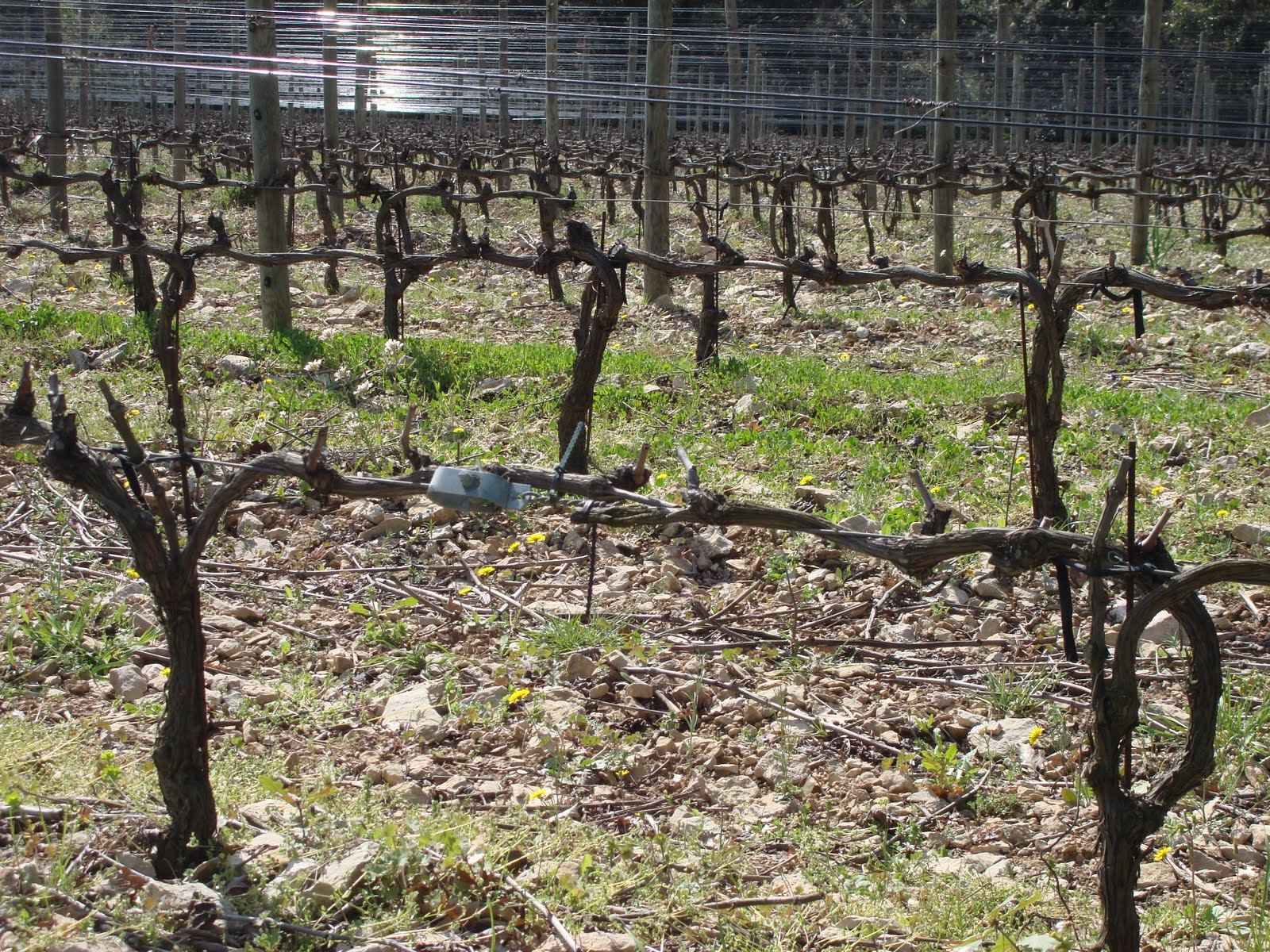
The Pic St. Loup region is a young region and the Château de Cazeneuve is a young winery. All the vines were planted over the past 20-30 years. And Andrée is still planting. He likes a white wine with rich and varied notes, cask-fermented. He has thus planted white grenache, viognier, roussanne, marsanne, rolle (aka fermentino) and muscat grapes. He will soon add another parcel to his whites on land he has himself cleared and prepared, no more than a hectare (2.2 acres) 400 meters higher in altitude than his other vineyards. Finding his white truly delicious, I'm delighted to note that Andrée has chosen to make a good quantity of white -- 25% of his full production -- so there is enough to export!
That the vineyards are young (but now old enough to produce concentrated grapes) is a plus. The vintners of this region are rarely plagued by problems of poor and over-taxed soil, nor with insect infestations. Surrounded by woods and isolated from other cultivated fields or orchards, they can more easily opt for organic methods with little worry of contamination.

After chatting, exchanging, learning and enriching our friendship, I walked away with two of his wines (I can't carry more at the moment!) to bring with me to Portland, OR and this summer to Chicago. His lovely white (hmmmm) with a rich blend of five of his grapes, supported by the rich Roussanne, cask-fermented and designed to age beautifully (oh the 2006...) and his classic cuvée, Les Rocs des Mates of grenache, syrah and mourvèdre aged in cask. The dense and rich grapes are balanced by their passage in oak (multi-passage), leaving the tasting with a sensation of pleasing freshness. I inhaled a blend of spices and toasted notes. A masculine and concentrated wine with good aging potential.


Tuesday, April 6, 2010
Domaine Coston

When a family chooses to work together much is possible. A father who encourages and offers responsibility to his sons, an elder brother who admires and follows his more experienced younger brother. And yes, Mom who holds up the rear coping on all that tiresome administrative paper work! But then again, this was her property, her dowry. She inherited it when she was only eighteen and her husband joined her to manage it till their sons were of age.
When a team such as this unites, what can stop them? The Coston family is now into its fifth generation of wine makers. They've owned their village home and cellar in Puéchabon along with various parcels of vineyards in the surrounding hills and plateaus for nearly forever. And now they are expanding and exploring new options.
The sons, Philippe 35 the man in the cellar, Jean-Marie 39 main marketing man and cellar assistant, joined their father -- the primary person managing the vines -- in 1998. Quickly the choice to cultivate organically became both desired and obvious. Living and breathing phyto-chemicals one more year was out of the question.

Strong arms and youth have led them to renovate, replace and improve. The cellar is filled with small stainless steel tanks permitting the individual vinification of each parcel and each grape varietal. The top cuvée red is aged in new oak, about a third of which is renewed yearly. The tasting room is beautifully and simply renovated, with a majestic stone well right there (should you prefer water to wine), an ancient iron wheel with spokes its protective door.
The vines range from fifteen years' old to sixty (the vieille vigne Carignan). And shortly, there will be eight new hectares (18 acres) planted in the red varietals so cherished in these parts: Syrah, Grenache, Mourvèdre and a handful of Cabernet Franc.

I came to visit, to taste, to see. But to see the vineyards you have to hop into a jeep and head off to the hills. The Coston family has purchased land high up on the plateaus of their region. After passing by a château, neighboring vineyards and abandoned olive orchards, we headed up a rutted and rough dirt road, through the scrub oak and herb encrusted limestone range (perfect for hiking and mountain biking!). Till... we arrived.

For the serious oenophiles amongst you, it is possible that this road, and the land that lines it has a familiar look to it... Anyone remember Mondovino? Well, when Robert Mondavi and his family were unable to purchase this parcel of land in the Languedoc, it went back on the block. Or actually, when he attempted to purchase it, the French agricultural governmental agency that tries to keep good land in the hands of those who will till it and cultivate it opened up the sale to local vintners and through a strenuous list of criteria selected the Coston family as the beneficiaries of the right to purchase. Thus, though they couldn't put the funds forth that Mondavi might have, they were able -- after ten years of haggling and persistence -- to obtain this land.

They have now done to a portion of it what Mondavi would have done to all of it. They have removed the Garrigue and chewed up the massive limestones to render the area plantable. It is somewhere between a lunar landscape and the top of a barren mountain. Gone are the wild oak, the rosemary, the thyme. And with the passage of the massive stone crusher, what was monumental stones has become shale.

The view is fantastic, the site extremely promising, and the possibilities tantalizing. Down below are the vineyards of the Grange des Pères, long a favorite of the region.
With this land the family will not quite double their production. Plans to expand the cellar are already necessary. Perhaps it is a good thing that grape vines require a minimum of three years before they become productive.
Meantime, the next generation -- currently 5 1/2 and 3 months -- will grow and who knows? Happiness and success is contagious after all.
But yes, it is a winery, right? And I am looking to bring their wines to the US -- currently to Portland, OR and to Chicago this summer. This was the (ostensible) reason for my visit (and for my brief moment of being lost as I manoeuvred around Montpellier).
After tasting all five of their wines I chose two of their range to bring with me to the States this year: their white which I found rich in orchard fruit and yellow flowers, long in the mouth, aromatic and pleasantly different. It is made with Roussanne (think Châteauneuf-du-Pape, a concentrated and rich grape that ages well) and Grenache Blanche. I tasted the 2006 and was quite wowed.
My favorite of their three reds (a vin de pays, their classic and their top cuvée aged in wood) was their classic. Called Les Terrasses du Larzac it is their coeur de gamme. It was simply (and most carefully) vinified in stainless steel tanks, no wood. The pleasing result is deep fruit flavors of black cherries and exotic spices. Mmmmm
Monday, February 22, 2010
Shall the wine finally be sold on American soil?
Well, I spent yesterday at the winery. Yes, in the beginning it was awkward, but hey, business is business and I've been working for a while to increase the awareness of JP's wines to the American public. So, when two very interesting importers are available to come visit and taste, well, I'm going to be there and make sure that it all goes smoothly.
And so it did. JP had gotten the house in order and prepared the wines. I brought a quiche and bread to nourish he who needed it before the next rendezvous in Montpellier.
Our first visitor was an importer/distributor from Boston who works throughout the New England area. He specializes in French and Italian wines and impressed us immediately with his timely arrival, his compliments for my directions, and his superb French. It is not everyday that we meet an American whose French surpasses mine! Son of a diplomat, educated in North Africa, and with a great sense of humor, he knows his French wines and tremendously impressed JP. He also knows his market and told us that though he's sold more wine in the past year, his income has gone down, not much, but nonetheless a bit. So, the conclusion is that wines in the 10$ range are the easiest to sell at the moment, and that ours would be just a touch above this. I believe he liked our classic red Tradition 2009. Will he take this further? I'm not sure. But for all of you who might be able to purchase the wine in your neighborhood (anywhere in New England) should you be so inspired, you could send an email to Hugh MacPhail at Idealwines... just a wee note, nothing overwhelming.
As he set off I received a phone call and helped direct our next visitor to the winery. GPS isn't very useful in these parts unfortunately. Seth or Salamanzar is co-owner of the Wine Authorities store in Durham, North Carolina devoted to small estate wines at reasonable prices. He particularly likes organic/bio-dynamic and was delighted that we are. He had a rendezvous just 45 minutes later in Montpellier, so not having a lot of time to chew the fat we got right down to the tasting immediately upon his arrival. Serious, present, interested, we went through the full range. We discussed the red Vin de Pays in 3Litre bag-in-box, the rosé ditto, and the two top reds. He was very interested in all the wines, and pleased with their price ranges. Apparently North Carolina (or the triangle area) hasn't been too hard hit by the economic crisis. Fascinating and good news for us. So, for those of you in this area (Teresa! Dorette!) do feel free to whisper a word into Seth's ear and perhaps you'll have some lovely Domaine Cabanis to purchase in the near future.
The ViniSud Wine Fair in Montpellier is what drew these men to the neighborhood at this time of the year. Happily, I was able to piggy-back on their presence and get them out to taste and visit. Definitely a strategy to work in the future as well.
And so it did. JP had gotten the house in order and prepared the wines. I brought a quiche and bread to nourish he who needed it before the next rendezvous in Montpellier.
Our first visitor was an importer/distributor from Boston who works throughout the New England area. He specializes in French and Italian wines and impressed us immediately with his timely arrival, his compliments for my directions, and his superb French. It is not everyday that we meet an American whose French surpasses mine! Son of a diplomat, educated in North Africa, and with a great sense of humor, he knows his French wines and tremendously impressed JP. He also knows his market and told us that though he's sold more wine in the past year, his income has gone down, not much, but nonetheless a bit. So, the conclusion is that wines in the 10$ range are the easiest to sell at the moment, and that ours would be just a touch above this. I believe he liked our classic red Tradition 2009. Will he take this further? I'm not sure. But for all of you who might be able to purchase the wine in your neighborhood (anywhere in New England) should you be so inspired, you could send an email to Hugh MacPhail at Idealwines... just a wee note, nothing overwhelming.
As he set off I received a phone call and helped direct our next visitor to the winery. GPS isn't very useful in these parts unfortunately. Seth or Salamanzar is co-owner of the Wine Authorities store in Durham, North Carolina devoted to small estate wines at reasonable prices. He particularly likes organic/bio-dynamic and was delighted that we are. He had a rendezvous just 45 minutes later in Montpellier, so not having a lot of time to chew the fat we got right down to the tasting immediately upon his arrival. Serious, present, interested, we went through the full range. We discussed the red Vin de Pays in 3Litre bag-in-box, the rosé ditto, and the two top reds. He was very interested in all the wines, and pleased with their price ranges. Apparently North Carolina (or the triangle area) hasn't been too hard hit by the economic crisis. Fascinating and good news for us. So, for those of you in this area (Teresa! Dorette!) do feel free to whisper a word into Seth's ear and perhaps you'll have some lovely Domaine Cabanis to purchase in the near future.
The ViniSud Wine Fair in Montpellier is what drew these men to the neighborhood at this time of the year. Happily, I was able to piggy-back on their presence and get them out to taste and visit. Definitely a strategy to work in the future as well.
Friday, January 29, 2010
Three days of Organic wine

Three days of wine and wine and wine. Three days of chatting, tasting, sharing, learning. Three days spent meeting importers to the US, Denmark, Norway, Holland, Germany, Belgium, England and Ireland markets. Three days of discussing, commenting, sniffing, and tasting. Three days of early mornings, late evenings, hopes, excitement, moments of boredom, too much good organic food (a super caterer does the noon-time meals).

I was there with two goals: to help JP sell his wines, particularly to the US market, but of course to anyone who needed me to speak English with them. And, to discover and taste wines from other wineries to build my own portfolio of wineries whose wines I would like to help enter the States.

To that end, as time permitted, I tasted wines of Pic St. Loup (a region I adore, though their wines are a bit pricey for our relatively slow market perhaps -- generally from $20-$35 with the current exchange rate). I also made an interesting connection with a small biodynamic winery in the Loire Valley, with an Alsacian winery that also has holiday rentals on site and the possibility to offer meals, tastings and more for visitors, and a woman-run winery in Perpignan (right by the Pyrennees) with numerous very very interesting wines both blends and single varietals.

Yes, I am moving forward. Best to start slowly and carefully. I've still much to learn about the basics of exporting wines to the US. Paperwork, labelling, Customs' duties, State differences (of which there are more than you can imagine!). But the fun part is getting to know the wines and the persons who make them.

My plan is to have the majority of the wineries I work with be within easy driving distance (relatively) and be willing to work with me on wine tours receiving curious visitors as well as being an agent who can place their wines in the US market. And of course, each time I visit them, I will photograph and write and describe. For what else this blog? A chance to share the discoveries of people, places and more.
When not running about tasting others' wines and presenting myself, I was a diligent assistant pouring and discussing JP's wines, trying to suss out the perfect match with visiting importers. I was pleased to see that my advance work contacting these importers had paid off and most came by to visit and taste our discreet selection of wines.

Our neighbors in all directions had a larger range of offerings than we. In Alsace, no matter the size of the winery, it will make seemingly at least a dozen different wines -- in some cases 500 bottles or fewer per style! And, for those in Languedoc, lacking in many cases a known name or AOC, they have opted to enter the international market with the more easily understood single varietals, using creative labeling, etc., Not quite the critter labels of Australia, but often in that general direction.
We have our two whites, one rosé, and three reds. All are blends, and though there are differences in the labelling, they are minimal: two vin de pays du Gard, three AOC Costières de Nîmes (the three colors) and a red cuvée prestige (the Jardin Secret). The bare minimum.

Behind us was a négociant who had a wide range of wines from many parts of France -- one stop shopping if you will. All organic, all with friendly and attractive labels, and all very inexpensive. One prominent American importer spent most of his time with them. Disappointing for us, the private, personal and small winery, but understandable. Easier to work with a négociant who knows the ropes and has lots of offerings than a small, individual winery. Ah well. Do we really want to be on supermarket shelves?

It's an art knowing into which market you fit. Wine stores are one area, but only the folks in the know will shop there. Organic supermarkets are another -- Wholefoods being the holy grail of course. But no doubt, there is a large potential in any supermarket lucky to be in a state that permits them to sell wine, particularly if you can come into the US in the $10 and under range...
But then do you change your label to adapt to that market? Is your labelling in sync with the product in the bottle and the potential drinker who will buy it?
When we look at the many many possibilities on display at the wine fair, it is both encouraging and destabilizing. Should we update the label? and if so, in which direction? It's great to have wines that will retail in the US at a reasonable rate (likely $10-$12), but we don't want the elegant label to count against them, nor a flashy label to demote them.

Now, home, I've a list of contacts to follow up with -- both for Domaine Cabanis, but also for myself. Price lists, wine descriptions, meetings to envision and plan, visits to their respective wineries where feasible... Exciting...

Tuesday, September 15, 2009
Testing for grape maturity

Today was a day to harvest the Syrah. Being a Tuesday, normally I wouldn't have been at the winery, but I'd forgotten the folder with all my important papers/documents (lawyer's letters, CAF, Sécu, taxes, ID, etc.,) at JP's and I just needed to have them within reach. I should be able to lower my property taxes this year as the divorce is pronounced, and I've been legally separated and caring for the boys on my own now for more than a year. The Avignon house still has both our names on it, but I've been the sole person responsible for it both in fact and legally, so, with papers in hand, I should be able to go and plead my case.

Thus, once I'd dropped the kids off at school I drove over for the day. Being there, I made lunch (a simple savory tart with caramelized onions, garlic, garden tomatoes and a couple anchovies, peppered with Aurelie's goats' cheese) and stayed long enough for a brief sieste (standard procedure) and to accompany JP on his early afternoon visit to the vines.

The morning had been spent harvesting, de-stemming, and then pumping the Syrah grapes into the tanks. These were the last of the Syrah from the special planting of his Jardin Secret. The grapes were already at 15 degrees alcohol -- rather high for Syrah--, and yet they weren't completely at the maturity JP desired -- due to the minimal rain-fall, the vines had simply stopped maturing, having put themselves on hold. Nonetheless, he felt it justified to harvest them now rather than to await tonight's rainfall, and the following 3-4 days it would require for the grapes to benefit from the rain, continue to mature, and hopefully be in shape for harvesting next week. It's always a gamble. And as there's been both mildew and oidium on the vines this year, waiting would allow these illnesses to spread, and he could potentially lose most of the harvest. So, the decision was made and the Syrah is now in the tanks, cooling down tonight. The careful and controlled fermentation will get going tomorrow.

The Syrah is the earliest-ripening grape (the French use the word précoce, or precocious in this instance) of the vineyard, and makes up between 25-40% of the winery's different blends. The rest of the domaine is planted in Carignan, Grenache and Mourvèdre. So, with a rendez-vous scheduled this afternoon with the oenologist, it was time to go out and randomly pick a selection of grapes from the the Mourvèdre and Grenache vines to check their maturity.

JP armed himself with two pails and a pair of clippers. We hopped into the little farm truck and bounced over to the parcels. He picked 4-5 small bunches from each area and added an identifying leaf (those in the know can recognize grape varietals by the leaf patterns). He tested a couple grapes by crushing them between his thumb and his index. By doing so he could see the color of the seed, whether the pulp still clung around the seed, as well as the thickness of the grape-skin, and the resistence or lack there-of to the pressure of his digits.

Neither varietal was as yet ripe -- which is what he expected. Once down at the cellar, he will crush a selection from each pail of grapes and then take the resulting grape juice and spread it on a refractometer (I do believe that's the word), a tool which takes the density of the sugar content in the fresh grape juice and lines it up on an easy-to-read scale to indicate the future alcohol degree.

Yes, there are tales of traditional vintners simply taking a grape, crushing it in their fingers, and tasting it, knowing empirically whether it is ripe or not. However, others (particularly those who are a bit more humble) use both these age-old visual and physical clues, and the aid of a marvelous and quite accurate tool.
Sunday, September 13, 2009
A day for pressing

The Costières de Nîmes AOC (appelation d'origine controlée) has not always had a reputation for quality. You can count on it to be a concentrated red wine of the South. Good for what ails you and a good companion to steak, lamb stews and such hearty fare. Not every bottle is elegant and refine, with the potential for cellaring. However, this is changing, not for everyone, but for a few.
It requires more work, more attention, and perhaps the hiring of an oenologist to work alongside you as you harvest, press, ferment, decant, and bottle. This week, you can quickly perceive who has chosen to shift gears and aim for quality, and who is content with how things have always been done. Look around you, on either side of the small roads atop the plateaus there are still pickers in the vineyards, and small tractors chugging gently down to private village-based cellars. It may be Sunday, but these men and women are tending to their fermenting grapes, dashing off just after breakfast, and right after their brief noon-time sieste, to the tasks that need doing today, not tomorrow. The vintners and vineyard owners who work with the Cave Coopérative finished up last week. Already the roads are cleaner, the sloshing juice spills rarer. Those huge over-filled bins trailing behind impressive tractors are no longer blocking the road.

At Domaine Cabanis not even half the harvest is in. Careful attention is made to harvest at the right moment; daily the grapes' sugar content is tested, and estimates judged taking into account the local weather predictions. A team of 6-8 men and women are on call this month, ready to come in the next day at 7AM, or to wait a day or two till the next parcel is ready. Picking the grapes at the optimum moment is the goal of every conscientious vintner seeking to make the best wine possible from his grapes.

At the Cave Coopérative, they make perfectly good wine. It is made with care and "correctly" as they say here. But the many small and large-sized vintners who depend on this cellar fit into the schedule provided. It cannot be denied that for a substantial majority, the goal is simply to press out some liquid and get it onto the market -- simple and inexpensive wine sells often more easily than top quality. For them it is speed and facility. They choose not to take any risks, thus protecting their harvest from the potential damage of fall storms, temperamental weather, etc., (for example, they're announcing rain for Tuesday... will it be followed by a drying mistral wind? or by heavy and hot humidity? will the grapes still on the vines recover? or will they rot?).
The quality of the grape, its ripeness, its skin, its health: these are the primary materials, and if they're not right, there's only so much you can do in the cellar to improve on the beverage into which they will be transformed. Green grape seeds can bring bitterness to the final product. The careful vintner will crush grapes in a small bowl, view and then taste the seeds for maturity. One amongst a number of elements he observes and calculates.

This weekend the syrah for the vin de pays and classic AOC red, finished its eleven days of fermentation. The juice of the drip was removed from the solids Friday afternoon, and transfered to a different tank where it will rest quietly and decant the remaining solids in suspension. Saturday thus, was the day devoted to pressing the remaining solids, le marc, remaining in the tank. The vintner, or his helper (when not in bed with the flu) gets into the tank (with a fan going above his head to prevent any carbon dioxide intoxication/fainting spells) and shovels out the marc into the awaiting slide attached to the pump which sends it to the press. At the press the helper (or vintner, depending on the skill at shoveling of said helper) directes the large stream of solids, distributing it evenly throughout the press. It took three rounds of shoveling and pressing to get through all the solids.
Once the pressing was finished, it was time to fully clean, brush, and rince out the tank, the press, the pump, and all the tools used during this process. By the time we were finished it was 8PM, time to retire to the mas and enjoy a good night's sleep.

A very physical and visually staining sort of day. Lots of hosing down, shoveling, manipulating, cleaning, physical labor. The kind of day where someone like myself -- i.e. energetic but not particularly experienced -- can be put to work. Thus I too have legs stained with grapes, hands turning black (best cleaned with pure bleach), and slightly sore shoulders. But, I do enjoy getting my hands dirty, so no complaints!

Sunday dawned with more to be done. A remontage of the carignan (pumped out of the tank, and back in, with the goal to air the liquid, and mix back in the solids that often float to the top of a tank). The transfer of the pressed juice from yesterday to another tank, and the removal of the lees remaining on the bottom of the first tank. It then needed to be fully rinsed, disinfected, and rinsed again to be readied for the clairette (green) grapes that will be picked and pressed tomorrow morning. As with so many activities, the clean-up is as important as the task accomplished, and takes nearly as much time.
I did what I could to help, and still feel it in my hands, wrists, shoulders... then I dashed off to get my boys. It was 5:30PM when I said goodbye to my vintner, and wished him a short evening's labor in his cellar. Yes, a Sunday evening during harvest season ... At least in this country, we do stop for a proper lunch (I made a lovely curry with pork, onions, tomatoes, peppers, a touch of yogurt and tahini...) and a short nap before returning to work. So even when things are stressful and consuming, reason and civility have their place.
Wednesday, September 9, 2009
Learning about Wine - a life-long class
It seems apt to speak of wine at a time when so many friends are working strenuously to bring in what appears to be a great harvest. Today wine is an integral part of my life. It just is. I don't necessarily drink it at every meal, but it surrounds me, enriches me, and tempts me in many a myriad of ways. It is a pleasure, and a staple.
When I first moved to France, I was not a complete neophyte, but almost. I'd been lucky to be raised by parents who enjoyed good French food (Julia Child, the Galloping Gourmet and Simone Beck), cooked it well, and accompanied it with wine from our cellar -- often brought back by boat (La France) after a trip to Europe--or purchased from a neighborhood wine shop. There were memorable meals throughout my childhood when my parents checked the Zacky's ads in the New York Times, saw that the lovely Montrachet or Vosne Romanée in the back of the closet was now listed as having a worth of $100, and chose it as the honorable partner to a feast of juicy steak, home-made sauce bernaise, buttery pop-overs, Mom's favorite blue or roquefort cheeses and a dark chocolate mousse. Or the menu might have been my mother's Canard à l'Orange, multiple vegetables, simple rice and a pecan pie laced with bourbon. Festive occasions these were.
My father had an ancient silver sieve handed down from his elegant mother (or grandmother?) to be used when ever so gently decanting the wine into the crystal carafe of similar origins. In those days, sediment at the bottom of a bottle was normal and far from shocking nor dissuasive, so we carafed old wines to remove the sediment. I mention this, as many of my vintner friends today are very concerned with filtering their wines so that no sediment appear and discourage wine buyers/drinkers. For me, this was always a normal aspect of old wines. But times change, and so have wine drinkers.
My parents weren't wine snobs, but they each proudly reinforced a European tendency in the other. Early on in their graduate student days they adopted the tradition of drinking this favored European breuvage at nearly every meal -- long before the health benefits of a daily glass of wine were being touted by the journalists.They were adept pourers of the large bottles of Gallo "chablis" and "burgundy," their choice (being modest and college professors after all) more often than their more valuable, cellared bottles.
When I headed off to college in the mid 1980s my father turned me on to the $3/bottle Trakia as a cheap and drinkable option. I believe it was Bulgarian... And my mother gave me advice for choosing a nice bottle to bring to dinner: beyond certain wine region names, look for mis en bouteille au domaine/au chateau. The advice worked, and upped my reputation amongst more avid wine afficionados in my social sphere (you can imagine, there were a few at Princeton).
My parents were, however, highly selective when serving their better bottles. The lucky few were not necessarily the people they loved best, though of course, this was the case for at least one couple. There were perhaps a dozen dignes de l'honneur, the primary requirement being a sensitive palate and sufficient wine knowledge to notice and perhaps applaud what was in their glass. In the 1970s, wine appreciation in the US wasn't particularly wide spread (particularly in Westchester NY); nothing at all as it is now. And so at our table a certain level of ceremony and carefully put together guest lists reigned.
I was encouraged to taste, but was too young to have my own glass. By the time I was of age (15/16), my parents were divorced and the quality of wine in the house lowered to mixed cases of anything under $10. This is not to say we didn't drink occasional, very good bottles, but those old Bordeaux and Burgundies are taste memories of a different time.
My time in Seattle led me to taste the wines of the Northwest, to wine-tasting evenings held by friends studying oenology, and to great feasts of salmon, shell fish and other local delicacies. Adult, I enjoyed and savored, but remained relatively ignorant.
And then, I arrived in France. My palate fifteen years ago was one that had been sensitized to the masculine, at times smoky flavors of those old Bordeaux, plus the rare Burgundy, but the decade since has been spent linked to the food and wines of Southern France. Here the fruit is ripe, the colors dark, the flavors rich and concentrated. I've been to dozens of wineries within an hour and a half radius of my home, tasted hundreds of wines, shared, poured and drunk many of each color. With Erick, I designed wine weeks, tasting at three wineries per day, pouring over the various nuances of the local Appélations, working our way through vertical tastings, and exploring the personalities of the local grape varietals, cépages.
My teachers are the vintners themselves. Passionate, generous, patient, they have answered every question, let us taste every wine in the cellar, including a number in the casks, tanks or still bubbling away. It has been an extraordinarily personalized and in-depth internship: from planting to harvest, from harvest to the bottle, from the cellar to the table; I've lived each of these steps and when possible, have brought clients and friends along with me.
And now, I'm dating a vintner, sharing his joys and woes as the harvest goes on (his main helper now has the dreaded Flu!), accompanying him to the wine fairs, co-hosting wine-tasting weekends at the winery, and assisting in placing his wines in North America. I'm there to assist, photograph, document and learn when he teaches organic viticulture techniques to his colleagues seeking to transition to organic. I'm there when he hosts an international intern hoping to get a feel for the craft. And yes, I'm there when the oenologists come to test, taste, and advise during the delicate moments of fermentation.
I'll not get a degree this way, but, I'm soaking it up like a sponge. Every glass of wine is now to be twirled, sniffed, tasted, swished around the mouth with an intake of oxygen, tasted again, and then yes, enjoyed with the meal at hand.
I stress that I've not become a wine snob, but a wine appreciator. Be the bottle at 2E or 100E, I will seek to discover its personality, aromas, flavors and mouth-feel. I know the work that went into these bottles, the pre-determined values set upon the various French appelations (Appélation d'Origine Controllée) , and I take it all in, withholding judgement, playing with hidden labels, open to pleasurable discoveries.
Drink on.
When I first moved to France, I was not a complete neophyte, but almost. I'd been lucky to be raised by parents who enjoyed good French food (Julia Child, the Galloping Gourmet and Simone Beck), cooked it well, and accompanied it with wine from our cellar -- often brought back by boat (La France) after a trip to Europe--or purchased from a neighborhood wine shop. There were memorable meals throughout my childhood when my parents checked the Zacky's ads in the New York Times, saw that the lovely Montrachet or Vosne Romanée in the back of the closet was now listed as having a worth of $100, and chose it as the honorable partner to a feast of juicy steak, home-made sauce bernaise, buttery pop-overs, Mom's favorite blue or roquefort cheeses and a dark chocolate mousse. Or the menu might have been my mother's Canard à l'Orange, multiple vegetables, simple rice and a pecan pie laced with bourbon. Festive occasions these were.
My father had an ancient silver sieve handed down from his elegant mother (or grandmother?) to be used when ever so gently decanting the wine into the crystal carafe of similar origins. In those days, sediment at the bottom of a bottle was normal and far from shocking nor dissuasive, so we carafed old wines to remove the sediment. I mention this, as many of my vintner friends today are very concerned with filtering their wines so that no sediment appear and discourage wine buyers/drinkers. For me, this was always a normal aspect of old wines. But times change, and so have wine drinkers.
My parents weren't wine snobs, but they each proudly reinforced a European tendency in the other. Early on in their graduate student days they adopted the tradition of drinking this favored European breuvage at nearly every meal -- long before the health benefits of a daily glass of wine were being touted by the journalists.They were adept pourers of the large bottles of Gallo "chablis" and "burgundy," their choice (being modest and college professors after all) more often than their more valuable, cellared bottles.
When I headed off to college in the mid 1980s my father turned me on to the $3/bottle Trakia as a cheap and drinkable option. I believe it was Bulgarian... And my mother gave me advice for choosing a nice bottle to bring to dinner: beyond certain wine region names, look for mis en bouteille au domaine/au chateau. The advice worked, and upped my reputation amongst more avid wine afficionados in my social sphere (you can imagine, there were a few at Princeton).
My parents were, however, highly selective when serving their better bottles. The lucky few were not necessarily the people they loved best, though of course, this was the case for at least one couple. There were perhaps a dozen dignes de l'honneur, the primary requirement being a sensitive palate and sufficient wine knowledge to notice and perhaps applaud what was in their glass. In the 1970s, wine appreciation in the US wasn't particularly wide spread (particularly in Westchester NY); nothing at all as it is now. And so at our table a certain level of ceremony and carefully put together guest lists reigned.
I was encouraged to taste, but was too young to have my own glass. By the time I was of age (15/16), my parents were divorced and the quality of wine in the house lowered to mixed cases of anything under $10. This is not to say we didn't drink occasional, very good bottles, but those old Bordeaux and Burgundies are taste memories of a different time.
My time in Seattle led me to taste the wines of the Northwest, to wine-tasting evenings held by friends studying oenology, and to great feasts of salmon, shell fish and other local delicacies. Adult, I enjoyed and savored, but remained relatively ignorant.
And then, I arrived in France. My palate fifteen years ago was one that had been sensitized to the masculine, at times smoky flavors of those old Bordeaux, plus the rare Burgundy, but the decade since has been spent linked to the food and wines of Southern France. Here the fruit is ripe, the colors dark, the flavors rich and concentrated. I've been to dozens of wineries within an hour and a half radius of my home, tasted hundreds of wines, shared, poured and drunk many of each color. With Erick, I designed wine weeks, tasting at three wineries per day, pouring over the various nuances of the local Appélations, working our way through vertical tastings, and exploring the personalities of the local grape varietals, cépages.
My teachers are the vintners themselves. Passionate, generous, patient, they have answered every question, let us taste every wine in the cellar, including a number in the casks, tanks or still bubbling away. It has been an extraordinarily personalized and in-depth internship: from planting to harvest, from harvest to the bottle, from the cellar to the table; I've lived each of these steps and when possible, have brought clients and friends along with me.
And now, I'm dating a vintner, sharing his joys and woes as the harvest goes on (his main helper now has the dreaded Flu!), accompanying him to the wine fairs, co-hosting wine-tasting weekends at the winery, and assisting in placing his wines in North America. I'm there to assist, photograph, document and learn when he teaches organic viticulture techniques to his colleagues seeking to transition to organic. I'm there when he hosts an international intern hoping to get a feel for the craft. And yes, I'm there when the oenologists come to test, taste, and advise during the delicate moments of fermentation.
I'll not get a degree this way, but, I'm soaking it up like a sponge. Every glass of wine is now to be twirled, sniffed, tasted, swished around the mouth with an intake of oxygen, tasted again, and then yes, enjoyed with the meal at hand.
I stress that I've not become a wine snob, but a wine appreciator. Be the bottle at 2E or 100E, I will seek to discover its personality, aromas, flavors and mouth-feel. I know the work that went into these bottles, the pre-determined values set upon the various French appelations (Appélation d'Origine Controllée) , and I take it all in, withholding judgement, playing with hidden labels, open to pleasurable discoveries.
Drink on.
Saturday, September 5, 2009
Le Vendange - The Harvest
All over the lower lands of Provence (this is relative as they are still atop plateaus) it is harvest time. Grape juice on the roads, workers up and about early in the morning, the presses, pressoirs, working at full tilt. Bins are filled, tractors are blocking traffic (or at the very least slowing it down). The weather has been wonderful, and today we've a cooling Mistral blowing through the vineyards. Hard to ask for more. 

Syrah, aka Shiraz, is the first of the red grapes to be ready for harvest. The team is out (predominantly female) from 7AM to bring the grapes in at their freshest (temperature-wise). The early morning is necessary as temperature control during fermentation is one of the arts of wine-making. Those who harvest by machine have been known to harvest from 2-7 in the morning... In fact, this is the case of at least one of the neighbors. Two bins came in this morning filling the 20 ton tank. The chilling system - reverse radiators fed by the well water under the cellar - was a bit iffy last night, but in fact is working fine, much to the relief of the vintner. This morning the tanks were at their proper temperature, and the day's work was put into motion. Besides removing the grapes from their stems, les érafles, there will also be multiple airings of the grapes and liquid, remontages, by which the juice and some of the grape solids are pumped out of the tank from below and poured back in from above, breaking any cap that might form atop the liquid, and encouraging a better mixture of the skins into the juices. This is desirable for a maximum extraction (same word in both languages).

This week a WOFeuse, i.e, an intern via the World Organic Farms association which places individuals from all over the world with organic farms for a proper internship, or a working vacation, is here from Paris. Normally a skilled store manager for a leather designer, travelling throughout the world setting up stores in Lebanon, Russia and South America, she is spending her vacation learning about wine from A to Z, and working the harvest. Energetic, willing and bright, she's trading room, board and a short education for her labor.

It's been a stressful week getting everything back into working order, amidst the presence of the electrician and the plumber working on the house above the cellar, etc., But at least the masons have removed their presence from the courtyard, having finished the new roof and flooring. It's been a race against time to have the cellar in shape for this harvest. But, after the first few kinks, things seem to be back in order, and all is moving along as it should. The viognier is looking lovely, currently evaluated at 14 degrees (a bit high for a white, but then again, this grape tends towards this), with rich fruit and amélique flavors (banana, English candy, malabar) inherent to the fruit itself.

The final rosé will be have approx. 25% syrah from this week's harvest. So far, so good. The cooler it is kept, the more delicate and captivating the fruit and floral aromas. It, like the white, has had the solids removed prior to fermentation, débourbage, and is progressing nicely.


Syrah, aka Shiraz, is the first of the red grapes to be ready for harvest. The team is out (predominantly female) from 7AM to bring the grapes in at their freshest (temperature-wise). The early morning is necessary as temperature control during fermentation is one of the arts of wine-making. Those who harvest by machine have been known to harvest from 2-7 in the morning... In fact, this is the case of at least one of the neighbors. Two bins came in this morning filling the 20 ton tank. The chilling system - reverse radiators fed by the well water under the cellar - was a bit iffy last night, but in fact is working fine, much to the relief of the vintner. This morning the tanks were at their proper temperature, and the day's work was put into motion. Besides removing the grapes from their stems, les érafles, there will also be multiple airings of the grapes and liquid, remontages, by which the juice and some of the grape solids are pumped out of the tank from below and poured back in from above, breaking any cap that might form atop the liquid, and encouraging a better mixture of the skins into the juices. This is desirable for a maximum extraction (same word in both languages).

This week a WOFeuse, i.e, an intern via the World Organic Farms association which places individuals from all over the world with organic farms for a proper internship, or a working vacation, is here from Paris. Normally a skilled store manager for a leather designer, travelling throughout the world setting up stores in Lebanon, Russia and South America, she is spending her vacation learning about wine from A to Z, and working the harvest. Energetic, willing and bright, she's trading room, board and a short education for her labor.

It's been a stressful week getting everything back into working order, amidst the presence of the electrician and the plumber working on the house above the cellar, etc., But at least the masons have removed their presence from the courtyard, having finished the new roof and flooring. It's been a race against time to have the cellar in shape for this harvest. But, after the first few kinks, things seem to be back in order, and all is moving along as it should. The viognier is looking lovely, currently evaluated at 14 degrees (a bit high for a white, but then again, this grape tends towards this), with rich fruit and amélique flavors (banana, English candy, malabar) inherent to the fruit itself.

The final rosé will be have approx. 25% syrah from this week's harvest. So far, so good. The cooler it is kept, the more delicate and captivating the fruit and floral aromas. It, like the white, has had the solids removed prior to fermentation, débourbage, and is progressing nicely.


Subscribe to:
Posts (Atom)